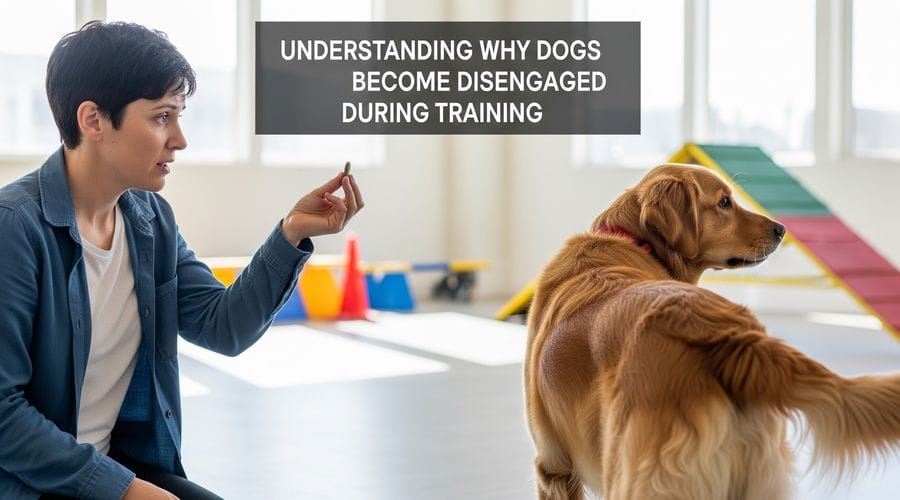
Your dog was doing great five minutes ago. Sitting on cue. Making eye contact. Tail relaxed. Then suddenly… he starts sniffing the ground. Scratching. Looking everywhere except at you. You repeat the cue. Louder this time. Nothing. It feels like he just stopped caring.
He didn’t. When dogs disengage during training, it’s rarely about stubbornness. It’s usually a sign that something in the learning environment isn’t working for them. And if you know what to look for, you can fix it.
Let’s break down what’s actually happening.
What Does Disengagement in Dog Training Really Mean?
Disengagement isn’t disobedience. It’s a drop in mental participation.
In simple terms, your dog has checked out. He’s no longer actively processing what you’re asking. Learning requires attention, emotional safety, and motivation. When one of those falls apart, focus follows.
From a behavioral science standpoint, learning depends on reinforcement history and emotional state. If the training session becomes confusing, stressful, repetitive, or physically uncomfortable, the brain shifts away from learning and toward coping.
That coping might look like ignoring you. But it’s communication.
Common Signs Your Dog Is Mentally Checking Out
Most dogs don’t dramatically walk away. Disengagement is subtle at first.
Physical signs of disengagement
- Turning the head away
- Excessive sniffing that suddenly appears mid-session
- Yawning or lip licking when not tired or hungry
- Slower response times
- Avoiding eye contact
- Sudden scratching or shaking off
These behaviors are often displacement behaviors. They show internal conflict or stress. They are not random.
Behavioral cues trainers often miss
- Offering known behaviors repeatedly without being cued
- Freezing instead of responding
- Hyperactivity after repeated corrections
- Performing the cue incorrectly in the same way again and again
When I see repeated “mistakes,” I don’t assume defiance. I assume confusion or stress. Dogs don’t repeat behaviors that aren’t reinforced unless something about the setup is unclear.
The Role of Stress and Anxiety in Training Disengagement
Stress is one of the biggest engagement killers. When cortisol rises, cognitive function drops. Research in animal behavior consistently shows that fear reduces learning efficiency and increases avoidance responses.
How fear-based methods impact learning
If training includes intimidation, leash pops, harsh verbal corrections, or unpredictable consequences, dogs may comply temporarily. But compliance under pressure is not engagement.
Fear activates survival pathways in the brain. Learning shuts down.
That’s one reason modern discussions at professional gatherings, including topics explored at veterinary conferences 2026, continue to emphasize low-stress handling and welfare-focused training methods.
Dogs trained through fear often show:
- Avoidance of the handler
- Slower responses over time
- Increased stress signals
- Emotional shutdown
You might get obedience. You lose trust.
Environmental stressors that affect focus
Even if your methods are kind, the environment might not be. Common stressors:
- Loud traffic
- Other dogs barking
- Unfamiliar locations
- Slippery flooring
- Temperature extremes
A dog can’t focus on heeling if he’s overwhelmed by the sound of a motorcycle passing by every 30 seconds.
Why Training Sessions Are Often Too Long or Too Repetitive
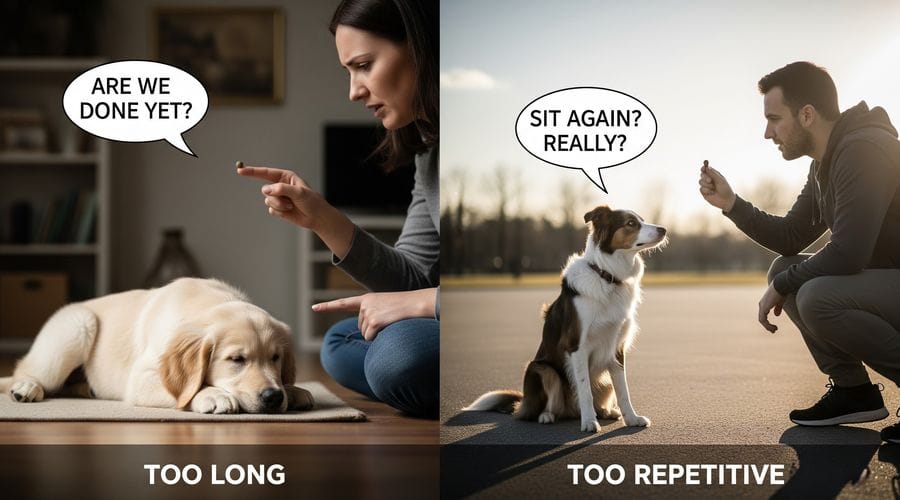
Dogs don’t have marathon attention spans.
For most dogs, 5 to 10 minutes of focused learning is ideal. After that, mental fatigue sets in. Repetition without variation also reduces motivation.
Think about it. If someone asked you to solve the same math problem 20 times in a row, you’d stop caring too. Signs your session is too long:
- Slower sits
- Delayed recalls
- Increased sniffing
- Wandering off
High-quality reps beat high-quantity reps every time.
Mismatch Between Training Methods and Your Dog’s Learning Style
Not all dogs are motivated by the same things. And not all dogs process information the same way.
Food-motivated vs. play-motivated dogs
Some dogs will work endlessly for tiny treats. Others lose interest after three repetitions but light up when a toy appears. If you’re using food with a dog who values tug more, engagement will drop fast. Motivation drives focus. Without it, training feels pointless to the dog.
Breed tendencies and individual personality
Breed traits matter. A Border Collie often thrives on fast-paced, mentally challenging work. A scent hound may disengage in visually focused obedience drills but excel in nose work.
Even in specialized programs like Protection dog training, trainers adjust methods based on the dog’s drives, nerve strength, and personality. One-size-fits-all approaches fail because dogs are individuals.
If your training method clashes with your dog’s natural tendencies, disengagement is almost guaranteed.
How Poor Timing and Inconsistent Cues Confuse Dogs
Timing is everything in learning theory. If your marker word or click comes even a second too late, your dog may connect the reward to the wrong behavior. If “down” sometimes means lie down and other times means stop jumping, confusion starts to build. And confused dogs disengage.
Many handlers don’t realize how often they blur the message. Repeating cues again and again teaches the dog to wait instead of respond. Accidentally rewarding the wrong behavior reinforces mistakes.
Changing criteria halfway through a session makes the task feel unstable. Using different words for the same cue weakens clarity. From your dog’s point of view, the rules keep shifting. When outcomes feel unpredictable, effort drops.
Clear cues, precise timing, and consistent expectations create security. Security creates engagement..
The Impact of Physical Discomfort or Health Issues

Sometimes disengagement has nothing to do with your training skills. It’s physical. A dog with hip discomfort may hesitate or avoid repeated sits. A dog with dental pain might ignore food rewards because chewing hurts.
Early arthritis can make agility drills feel exhausting. Even mild joint pain, gastrointestinal discomfort, ear infections, hormonal imbalances, or chronic fatigue can reduce focus and responsiveness.
Dogs are remarkably good at hiding pain. In many cases, reduced performance is the first visible sign that something isn’t right. When a dog who was once eager begins slowing down, avoiding certain movements, or losing interest in rewards, it’s worth looking beyond behavior and considering health. Training cannot override physical discomfort.
When to consult a veterinarian or trainer
If your dog’s disengagement is sudden or paired with behavioral changes, consult a veterinarian first. Rule out medical causes before adjusting your training strategy.
If health checks out, a qualified trainer can observe patterns you might miss. Training is behavioral. But behavior is biological.
Distractions in the Training Environment That Sabotage Focus
Distraction levels have to match your dog’s current skill level. If your dog can sit reliably in the kitchen but not at the park, that isn’t stubbornness. It’s context change. Dogs don’t automatically generalize behaviors to new environments. They have to relearn them in each setting.
Focus should be built progressively, starting in a quiet indoor space, then adding mild distractions, then moderate ones, and eventually high-distraction environments.
When we skip steps and expect advanced focus in overwhelming settings, disengagement is almost inevitable. Gradual exposure strengthens reliability. Rushing the process weakens it.
How Handler Emotions and Body Language Affect Engagement
Dogs read us better than we read ourselves.
If you’re frustrated, your breathing changes. Your posture stiffens. Your tone sharpens. Even if you don’t yell, your dog feels the shift. Tension creates tension.
Common handler behaviors that reduce engagement:
- Leaning forward in an intimidating posture
- Staring intensely
- Holding breath during cues
- Tight leash pressure
Calm handlers create confident learners. I’ve seen dogs re-engage instantly when the handler relaxed their shoulders and softened their tone. Sometimes the fix isn’t technical. It’s emotional.
FAQs
1. Is my dog being stubborn when he ignores me during training?
Most of the time, no. What looks like stubbornness is usually stress, confusion, fatigue, or low motivation. Dogs repeat behaviors that work for them. If engagement drops, something in the setup needs adjusting.
2. How long should a training session last?
For most dogs, 5 to 10 focused minutes is enough. Puppies and high-energy dogs may need even shorter sessions. Stop while your dog is still engaged. Ending on a win keeps motivation high for next time.
3. Can anxiety really affect my dog’s ability to learn?
Yes. When a dog feels anxious or overwhelmed, the brain shifts into survival mode. Focus and problem-solving decrease. A calm emotional state is essential for effective learning.
4. Why does my dog listen at home but not outside?
Dogs don’t automatically generalize behaviors to new environments. The park is full of smells, sounds, and movement. You have to retrain cues gradually in different settings, starting with low distractions and building up.
5. When should I worry that disengagement is a health issue?
If your dog suddenly loses interest, moves stiffly, avoids certain positions, or shows other behavior changes, consult a veterinarian. Pain, fatigue, or hidden medical conditions can quietly impact training performance.


Aris Suggest!
Walk in Style: Durable Dog Leashes and Collars for Every Adventure! —Explore Now! (Aff.link)