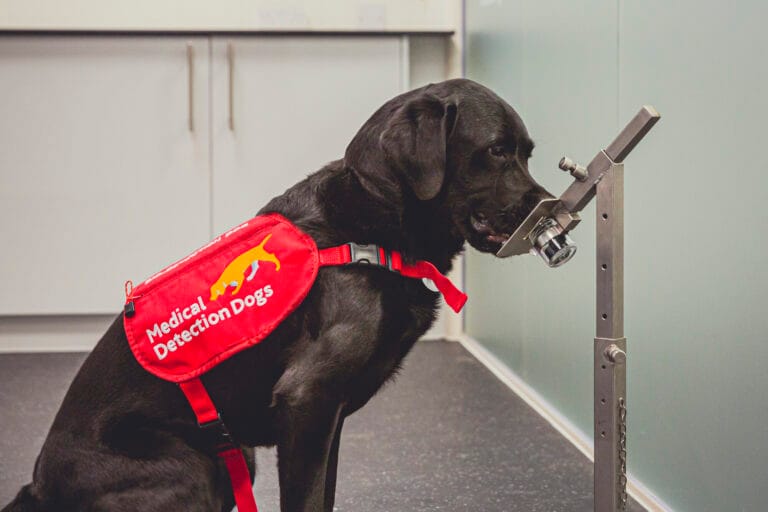

What cases would you expect a police dog to work on? It’s easy to imagine these highly trained dogs tracking missing people or fugitive, sniffing out drugs or weapons, or even cash – but did you know they can be vital to investigate sex crimes?
To labradors Ebony and Hazy, it is all a game: find the thing they were trained to sniff out, get a reward, rinse and repeat. They will never know that this game of theirs is making a huge difference to an investigation, and indeed to somebody’s life, by helping secure the conviction of sex offenders – because the thing they were trained to find is semen at sexual assault crime scenes.
Ebony and Hazy were trained by the Nottinghamshire Police, completing an intensive six-week programme of specialist training to detect seminal fluid. They are among a select few in the country trained to perform this highly specialised task – one that will be vital in helping police forces across the UK secure convictions.
“Dogs really are remarkable animals and can be trained in the same way to detect almost anything we want them to”
Their ability to detect microscopic traces of seminal fluid, even years after the crime has taken place, could prove indispensable in gathering crucial evidence for criminal investigations. Once these traces are identified, DNA profiles can be extracted and used in court to support the prosecution of offenders.
PC Dean Allen, now lead trainer with Nottinghamshire Police after a long career with Derbyshire Police, has trained both labs – as well as the majority of the semen-specific detection dogs currently operating in the UK. He was also the trainer of Billie, a police dog who joined Derbyshire police in 2014 and was reportedly the first trained in the UK to find semen at a crime scene. After taking part in 120 searches and finding “pivotal” evidence, Billie retired in 2020.
Speaking of the newest recruits, PC Allen said, “Dogs really are remarkable animals and can be trained in the same way to detect almost anything we want them to. Ebony and Hazy have been a real pleasure to work with over the last six weeks and I know they will play a very significant role in getting justice for victims.”

“They are now capable of detecting even the smallest trace amounts and will find evidence that may previously have been missed with other detection methods. Ultimately these dogs will be used in future to bring some of the very worst offenders to justice, and it’s a great feeling for us to play a part in that with our training.”
Detective Chief Inspector Jo Elbourn, who has many years of experience in investigating sexual offences, added, “Evidence gathered by these animals can really make all the difference in a rape or sexual assault investigation – particularly when suspects deny that sexual activity has taken place. By using DNA evidence detected by dogs, we can prove they are lying about the fundamentals of an investigation and build our case from there.”
Seminal fluid detection dogs have already been deployed successfully by Nottinghamshire Police. In 2021, a man was convicted and sentenced to 24 years in prison for offences committed against teenage girls years earlier. A semen sample recovered from a bedroom was a key piece of evidence, corroborating the testimony of one of the victims.
“The result is we can catch sexual offenders that we may not have been able to otherwise due to the very difficult nature of some sexual offence scenes”
In 2022 a dog called April, operating with the Cheshire police, was crucial in the investigation of the a sexual assault of a child. April, who at the time was one of only three dogs in the UK trained to detect seminal fluid, was taken to the crime scene by her handler PC Steve Gunn, and found traces of semen on the child’s duvet. This allowed police to collect samples as evidence.
PC Dean Allen, who at the time was Derbyshire police’s lead trainer, said, “In the last six weeks they’ve learnt to identify and search for that scent in numerous scenarios that we’ve set up for them: indoors, outdoors, in vehicles, on grass, tarmac, and materials such as bedding and clothing. The result is we can catch sexual offenders that we may not have been able to otherwise due to the very difficult nature of some sexual offence scenes.
“The dogs can indicate the presence of seminal fluid in places traditional kits can’t detect it and, once they’ve identified the scent, that piece of material or vegetation can be sent away and the extracted DNA profiled, leading to more prosecutions and offenders behind bars.”

This may come as a surprise to those who are not familiar with dogs’ incredible sense of smell: with all the technology now at our disposal, are trained dogs really more accurate than testing kits? A 2019 study published on Forensic Science International set out to answer that question.
“In sexual assault cases, the detection and identification of semen is extremely important as this type of evidence can be used as a source for investigative leads and contributes to case evidence. However, the detection of semen stains is often difficult, even indoors, because of different (environmental) factors, such as substrate type, coloured items and large search areas,” the study reads.
“In 2015, a project was initiated by the Dutch police to evaluate the feasibility of the use of detection dogs to locate semen stains in forensic practice. Since promising results were obtained, here, a double-blind study was designed to investigate how these detection dogs can optimally be implemented in the current work flow of crime scene investigators and to compare the dog’s sensitivity and specificity with current detection methods.”
Ebony and Hazy have big shoes to fill as earlier this year PD Sybil, the longest serving fluid detection dog in the UK, retired
In the study, the dog’s sensitivity is compared with the three most common methods for semen detection: forensic light sources (FLS), the RSID semen field kit, and the enzymatic Acid Phosphatase (AP) test. Each was tested on seminal fluid which was deposited on various types of fabrics.
The results demonstrated the exceptional performance of the detection dogs, achieving 100% sensitivity in identifying semen stains. This was in contrast to the more variable results of other detection methods, which recorded a sensitivity of 76.3% for FLS, 81.6% for the RSID test, and 92.1% for the AP test.
“Especially on fabrics with a pattern or interfering fluorescent properties, detection dogs demonstrated to be of additional value to locate the semen stains,” the study adds.

Ebony and Hazy have big shoes to fill as earlier this year PD Sybil, the longest serving fluid detection dog in the UK, retired.
“The vital role Sybil played in identifying some of the most serious sexual offenders in the country cannot be underestimated,” said her handler, PC Chris Morris. “Sybil, thank you for your exemplary service.”
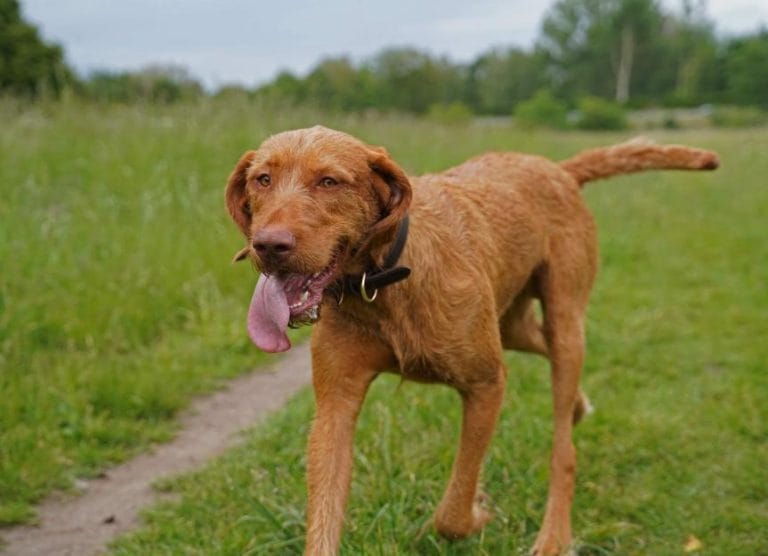
Hazy was trained specifically to replace Sybil in the Derbyshire Police force, and having completed her training with flying colours, she will now join PD Rosie in investigating sex crime scenes – and securing vital evidence against sex offenders across the UK.
This Post was originally published by Alessandra Pacelli from dogstodaymagazine.co.uk. Click here to read the original.

Aris Suggest!
Walk in Style: Durable Dog Leashes and Collars for Every Adventure! —Explore Now! (Aff.link)