
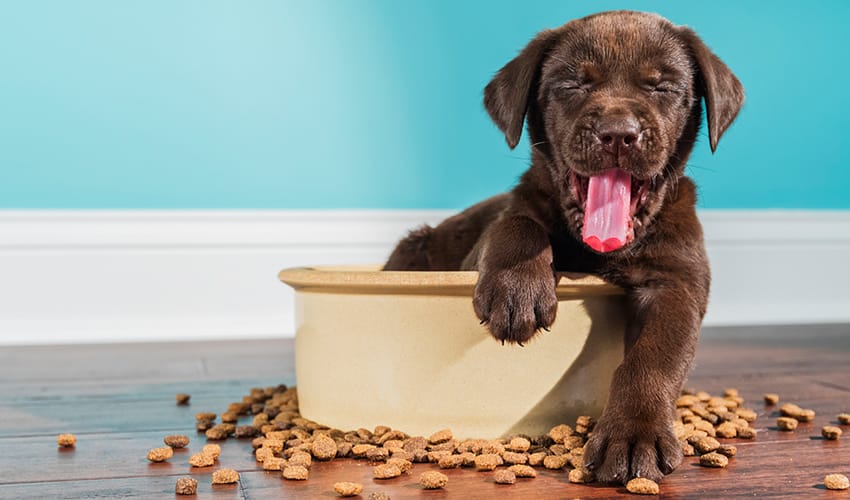
Dogs love dry food. It’s formulated for crunch, and coated in flavors meant to tempt your dog into licking its bowl clean. If that’s just what your dog is doing, you don’t need to add anything to its bowl to spruce it up — unless you want to add some supplements or healthy veggies.
In the article “The Chemistry of Kibble” by Mary Roach on Popular Science, the author describes her visit to AFB International, a company that makes liquid or powdered palatant coatings designed to make kibble taste delicious. Palatant can include proteins, yeast and antioxidants. Roach’s article notes that the main ingredients in AFB’s dog food palatants are liver mixed with other viscera.
“AFB designs powdered flavor coatings for the edible extruded shapes,” Roach writes. She explains that kibble on its own doesn’t have much taste. “The flavor comes almost entire from the sauce—by design.”
This enables pet food companies to produce one type of kibble and coat it in a variety of flavors, ready for retail. Kibble is designed to appeal to dogs and gets taste tested by hundreds of dogs at facilities like AFB International before it hits store shelves.
So, what gives? Why do some dogs refuse kibble? Is it the dog, or are owners looking for ways to get their dog more diverse nutrients when they decide to improve on kibble?
Either way, it’s easy to add some pizazz to kibble and make it more appealing.
Try raw coated kibble
Food brands are starting to come up with new products to work around kibbles’ bad rep for being a low quality food.
Raw coated diets use freeze-dried raw meat to coat the exterior of dry kibble. Sometimes, there are chunks of freeze dried meat included in the food. If you’re still partial to kibble and leery of raw, this might be a great entry product for you and your dog.
Freeze drying raw food helps reduce bacteria contamination and food producers also claim this doesn’t reduce the nutrients in the food like high temperature cooking does.
Raw coated kibble offers your dog an increase in protein and fat — two things dogs love.
Try baked kibble
Baked kibble is different from traditional kibble. In traditional kibble, the elements of the food are brought together and made into a dough, which is extruded through small dies that give it its shape.
Extrusion uses extremely high heat and pressure. Traditional kibble goes through cooking in the 200 to 250 Fahrenheit range, and the pressure creates steam and a burst of high heat. Kibble cooks in seconds.
Baked kibble is “slow cooked” and product producers claim the low temperature preserves the nutrients in the food. Baked kibble doesn’t get added fats and flavors because it is thought to retain its taste on its own. Also, it isn’t cooked with steam or under pressure. It is possible that oven baked food is easier for dogs to digest, but research on this is limited.
If you love the ease of kibble and want to try something new with your dog, baked kibble is an easy switch. Your dog might love it.
Try adding tasty toppers
Dog food toppers are meant to make regular food taste better and ideally provide a nutritional boost at the same time. Dry toppers can be used as treats too.
Topping possibilities for dog food are endless. Commercial products include bone broths, gravies, wet food, semi-moist meat treats, crunch single source air dried meats, or freeze-dried meat nuggets. They may contain probiotics, antioxidants, freeze-dried fruit, and other nutritional supplements, and they come in every protein flavor imaginable.
Toppers aren’t meant to be served in large portions: they’re meant to entice your dog into eating its dinner. Usually the package will say something along the lines of “this is meant for intermittent or supplemental feeding only.”
Toppers shouldn’t make up more than 10 percent of a dog’s diet.
If your dog is on a weight reduction plan, adding calories isn’t recommended, so try sprucing up dinner with veggies, flax, probiotics or something like the liquid from your can of tuna — delicious and lower in calories. There are powders that come in flavors like white cheddar cheese and are low calorie, but if you have a particularly small dog any extra calories may need to be avoided.
Try adding some supplements
If you pour some fish oil, yogurt or kefir on top of your dog’s food, they’re getting extra nutrients, but they don’t know that. They just know their food tastes great. It’s like hiding zucchini in brownies or spaghetti to get your kid to eat veggies.
Omega-3s found in fish oils help your dog’s coat, muscle function, and overall health.
You can even experiment by adding ground flax, chia seeds, spirulina (or other powdered veggies) to dinner. Dogs with inflammation can benefit from turmeric added to their food.
Always start with a small amount and stop using the product if it upsets your dog’s tummy.
Try a veggie “smoothie”
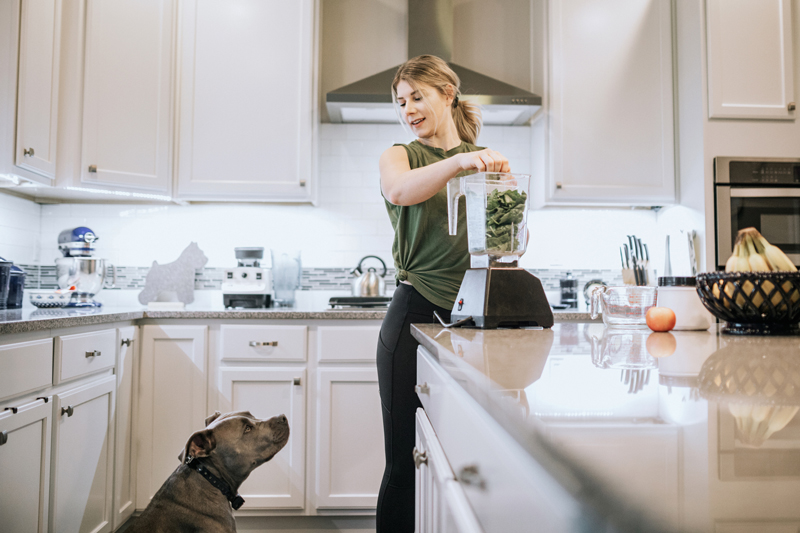
Dark leafy green vegetables are great for your dog. Kale, spinach, chard — these greens contain vitamins A, C, E and K. Other great veggies for dogs are carrots, pumpkin, bean sprouts, and green beans. Experiment to see what your dog likes — and what won’t make him or her gassy. Just never add onions of any kind to your dog’s smoothie. Onions are highly toxic.
To make it easy for your dog to digest these tasty vegetables, run them through the blender with some water and then mix into the kibble. This addition is also highly satiating while being low in calories, so is something even an overweight dog can enjoy.
Other tactics you can try at home to make dry food more appealing
- Add lightly steamed veggies to kibble.
- Add raw or lightly cooked eggs (and the shell) to the bowl. Don’t use butter or oil if you choose to cook the egg.
- Add goat’s milk or a dollop of cottage cheese (watch the salt content).
- Share your can of fish with your dog.
- Add some homemade, highly nutritious, unsalted bone broth.
- Put a little canned wet food on top of the kibble. Make sure to reduce the kibble portion slightly to accommodate the added food.
- Occasionally offer your dog a canned or frozen sardine. If it’s canned, make sure it comes in a water, not oil, base.
- If you have a juicer and make juice for yourself, pour a small serving over the kibble. Veggie based juices are best because they contain less sugar.
- Add a spoonful of coconut oil to dinner.
This Post was originally published by Laura from dogsnpawz.com. Click here to read the original.